What Good Sounds Like
The Audio Description People's Choice Awards, 2022–2025

This morning, I finished a three-part series on LinkedIn about the audio description pipeline and sign language pipeline in film and television—the infrastructure that delivers described content to blind and visually impaired audiences, and to everyone else who benefits from it. The first piece diagnosed the problem: no owner, no standard, no mandate. The second went inside the delivery chain. The third asked whose films, whose stories, whose cultural experiences that pipeline serves—and whose experience the industry has decided is worth preserving.
That series is done. This is where the work continues.
The LinkedIn essays documented failure because failure is documentable. Absence is measurable. You can show a landing page with no AD symbol. You can play a TTS track and let the register speak for itself. You can count the seasons of a show that arrived without description and note exactly where the pipeline showed up and stopped going back.
What’s harder to document is what good actually sounds like. Not compliant. Not a file delivered to spec. Good—the kind that makes a blind viewer realize, as Kim Charlson did the first time she attended an audio-described live theater performance, how much she had been filling in with things that probably weren’t even part of the show.
There is a place that has been trying to document it.
The American Council of the Blind (ACB) runs an annual Audio Description Awards Gala. The ACB is the organization that brought the 2016 settlement against Netflix requiring audio description for its original productions—the settlement piece two of the LinkedIn series examined, the one that expired in January 2019 and was never replaced. The Gala is one of the few places where audio description gets named, evaluated, and recognized publicly.
The 2025 sponsors include Amazon, Netflix, and Warner Bros. Discovery at the “Take the Lead” level: $10,000 each, which buys a 30-second pre-recorded segment aired during the ceremony spotlighting each organization’s commitment to inclusive media. Comcast NBCUniversal sponsors at the “Super Star” level for $15,000. Also sponsoring: Paramount, The Walt Disney Company, Fox Corporation, PBS, Microsoft, Spectrum, VITAC, NCTA, and Waymo.
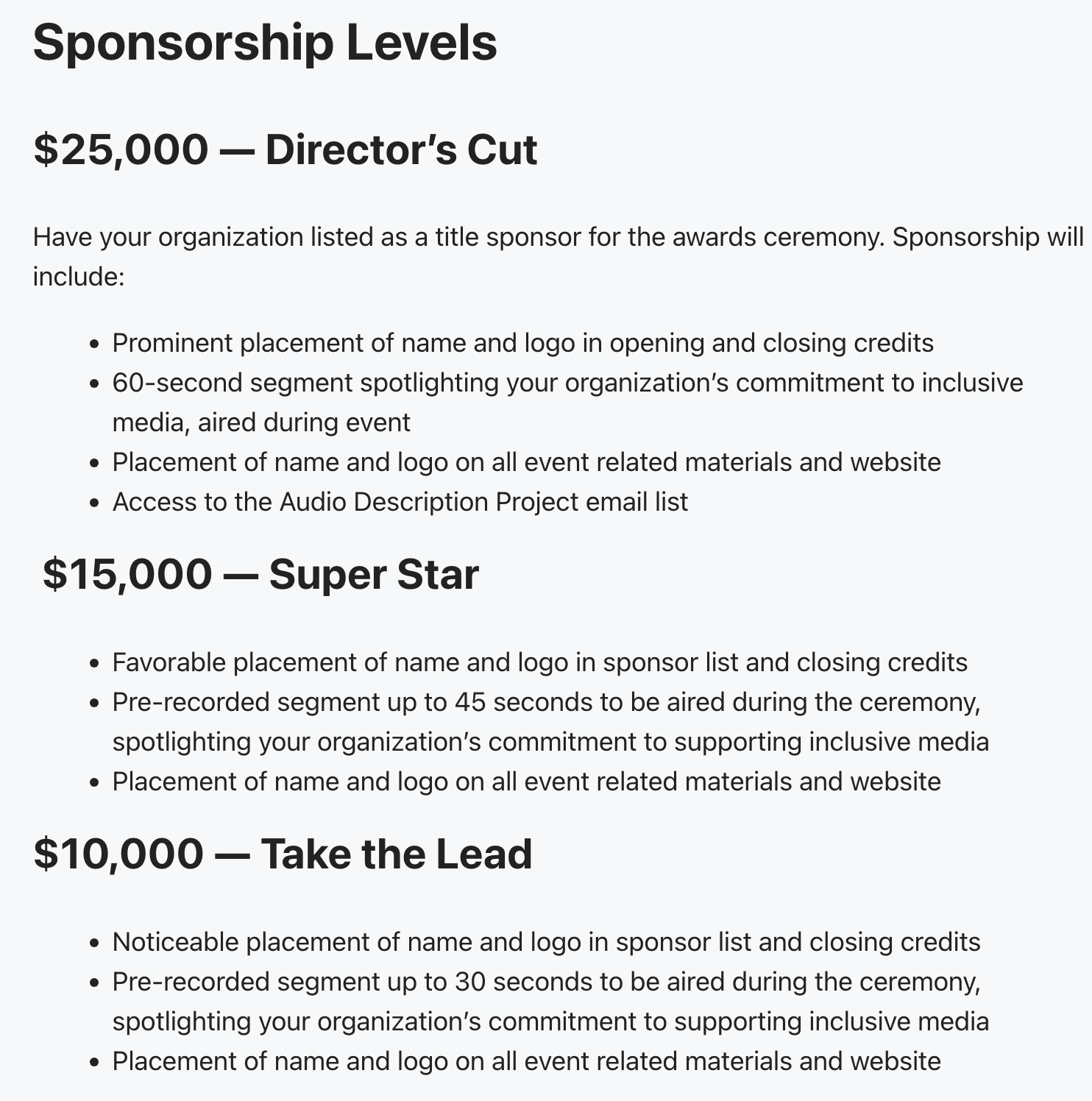
A screengrab from the Sponsors page of the ACB’s Audio Description Awards Gala.
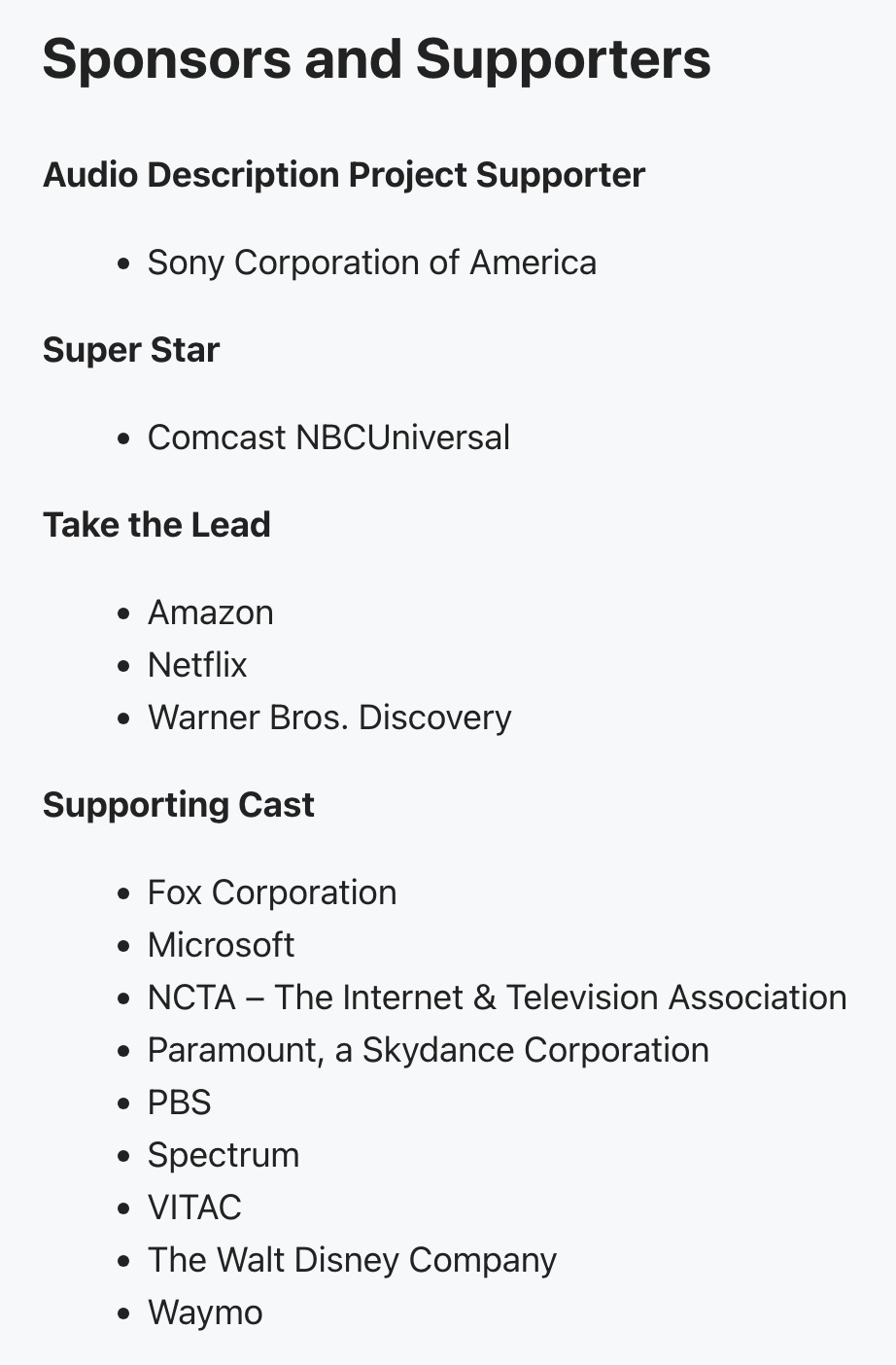
The official sponsors and supporters of the 2025 Audio Description Awards.
The companies whose AD practices the Gala evaluates are the companies funding the Gala and purchasing airtime within it to describe their own commitment to the thing being evaluated. That is worth naming because it is the architecture of most media industry recognition, and because the LinkedIn series documented Warner Bros. Discovery winning Outstanding Achievement for Live Events at the 2023 Gala—the same year its published content delivery specification contained no audio description requirements. The award recognizes what the industry can do. The sponsorship reflects who controls the conditions under which it does it.
This is not a problem unique to the AD Gala. The tension between recognition and the institutions that control recognition is one of the defining structural problems of awards culture broadly. The Golden Globes became a case study in what happens when the organization evaluating the work is effectively owned by the same entity soliciting money from the people competing for it—a conflict documented in detail by outlets including The Ankler. The Game Awards operates with a more transparent voting structure: a jury of identified press organizations, separated from the committee that includes Microsoft, Nintendo, and Sony, with fan votes counting for a disclosed percentage of the outcome. Neither model is clean. Both make visible something worth understanding: that the parameters of recognition—what counts as good, who gets to say so, and what they stand to gain from saying it—are never neutral. They reflect the priorities of the institutions that set them.
The AD Gala is not exempt from that dynamic. Naming it is not a dismissal of the work the ACB does, or of what the People’s Choice has produced over four years. It is the condition under which that work exists, and the lens through which the record should be read.
Among the Gala’s categories is one that operates differently. The People’s Choice.
Not adjudicated by a panel. Not determined by a committee of industry professionals. Open public nomination followed by a two-week public vote, administered by the ACB, evaluated against criteria that center the listening experience.
The nomination criteria ask voters to consider three things before submitting: the writing, the voicing, and the sound.
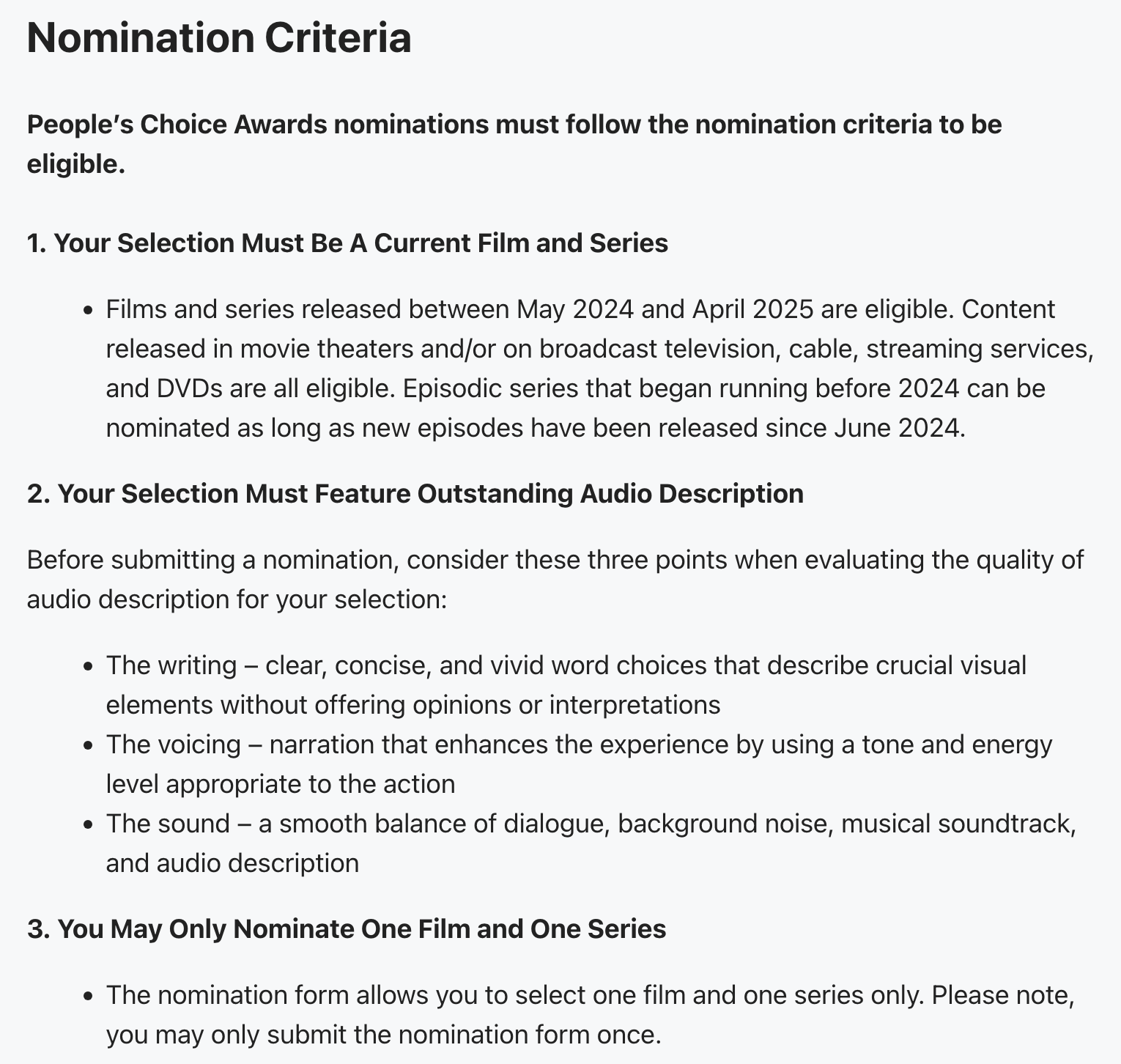
A screengrab of the Nomination Criteria required for People’s Choice for the Audio Description Awards.
That is a more specific quality framework than anything in Warner Bros. Discovery’s published content delivery specification. It is more specific than Paramount’s Global Content Delivery Guide, which requests descriptive audio when available. It matches, and in some respects exceeds, what Amazon’s AD Style Guide published in September 2025 requires.
The ACB built that framework. The industry hasn’t built an equivalent requirement.
Here is what I can’t tell you: whether the people voting are blind. The nomination page specifies what qualifies a title—release window, outstanding AD, one film and one series per submitter. It does not specify what qualifies a voter. There is no stated requirement that you be blind or visually impaired. No ACB membership gate. No verification mechanism described. I could nominate. You could nominate. I’m putting that into the record because this publication is about precision, and the People’s Choice deserves to be described accurately rather than presented as more than it may be.
What it is: a public vote administered by the blind community’s primary advocacy organization, evaluated against criteria that center the listening experience, with winners announced at a Gala whose audience is predominantly blind and visually impaired. Four years of that vote produces a record. The People’s Choice category was introduced in 2022—newer than the Gala itself, which has been running since 2021. The community built the people’s recognition mechanism after the institutional one already existed.
Here is what that record shows.
2025: FLOW and DYING FOR SEX
People’s Choice Film: FLOW (2024, Gints Zibalodis).
People’s Choice Series: DYING FOR SEX (2025, Elizabeth Meriweather and Kim Rosenstock).
If you read piece three of the LinkedIn series, you already know both of these titles. FLOW is a Latvian animated film with no dialogue. Every piece of narrative information is visual. DYING FOR SEX is a Hulu series about a woman with terminal breast cancer. Both received human-voiced AD. Both are on platforms that have produced some of the most inconsistent AD records in the industry. The community chose them anyway. Or chose them because of what they represent: proof that the pipeline can do this when someone decides it should.
A clip of FLOW. Sourced from HBO Max.
A clip from DYING FOR SEX Season 1, Episode 1—titled “Good Value Diet Soda. Sourced from Hulu.
2024: ALL THE LIGHT WE CANNOT SEE and DUNE: PART TWO
People’s Choice Series: ALL THE LIGHT WE CANNOT SEE (2023, Shawn Levy).
People’s Choice Film: DUNE: PART TWO (2023, Denis Villeneuve).
ALL THE LIGHT WE CANNOT SEE is based on Anthony Doerr’s Pulitzer Prize-winning novel. Its central character is blind. The AD track had to describe a visual world to a blind audience through the perspective of a character who is herself navigating without sight, without collapsing the distinction between what she perceives and what the camera shows. That is a craft problem. It requires a writer who understood what the source material was doing, not just what was happening on screen.
DUNE needs the AD track to paint the harsh landscapes of Arrakis, the black and white world of Giedi Prime, and the feeling of Paul Atreides riding his first sandworm.
A clip from ALL THE LIGHT WE CANNOT SEE Episode 4.
A clip from DUNE: PART TWO where Paul prepares to ride Shai-Hulud for the very first time.
2023: WEDNESDAY and EVERYTHING EVERYWHERE ALL AT ONCE
People’s Choice Series: WEDNESDAY (2022, Tim Burton).
People’s Choice Film: EVERYTHING EVERYWHERE ALL AT ONCE (2022, Daniel Scheinert and Daniel Kwan).
WEDNESDAY became one of the most-watched Netflix originals of all time the year it won. That scale matters because the argument for investing in AD quality is sometimes framed as serving a small audience. Piece one of the LinkedIn series addressed this directly. The CALL OF DUTY data addressed it. WEDNESDAY addresses it again from the other direction: the AD that earned recognition here was built for a show that everyone was watching.
A clip from WEDNESDAY Season 1, Episode 4—titled “Woe What A Night.”
EVERYTHING EVERYWHERE ALL AT ONCE won Best Picture at the Academy Awards that year. It was also, at the time, one of the most formally demanding films to describe: multiverse sequences, rapid cuts between realities, a climax that requires the AD writer to track emotional register across absurdist imagery without explaining the joke.
PARASITE won Best Picture three years earlier. Its US distributor, Neon, did not include AD for theatrical or home release. Bong Joon-ho had urged American audiences to overcome the one-inch-tall barrier of subtitles to access more films. He was unaware his US distributor hadn’t included AD. Tom Quinn, Neon’s co-founder, declined NPR’s request for comment.
Same award. Different distributors. Different decisions. The pipeline reflects priority, not capacity.
A clip from EVERYTHING EVERYWHERE ALL AT ONCE where Alpha Waymond comes to Evelyn’s rescue.
2022: OBI-WAN KENOBI
People’s Choice: OBI-WAN KENOBI (2022, Deborah Chow).
This was the first year of the People’s Choice. One category, before the Film/Series split was introduced in 2023. The community voted, in its inaugural choice, for a STAR WARS series.
Not a prestige drama. Not an awards-season film. A beloved franchise installment with an audience that had been following these characters for decades and for whom access to that return meant access to a conversation everyone else was already having. The People’s Choice said: the description made it possible to experience what that return felt like.
A clip from OBI-WAN KENOBI Season 1, Episode 5—titled “Part V.”
Four years of People’s Choice selections. Seven titles. A24, Netflix, Disney+, Warner Bros. Discovery—the same studios and platforms whose AD practices the LinkedIn series documented in full. The same companies sponsoring the Gala where these awards are announced. The same companies whose published delivery specifications range from rigorous to nonexistent.
All of them capable of this. None of them required to do it consistently.
The People’s Choice record is the blind community’s answer to a question the industry hasn’t asked itself: what does good actually sound like? The community has been answering it every year since 2022, with a public vote, against a quality framework they defined themselves, administered by an organization funded in part by the companies whose work they’re evaluating.
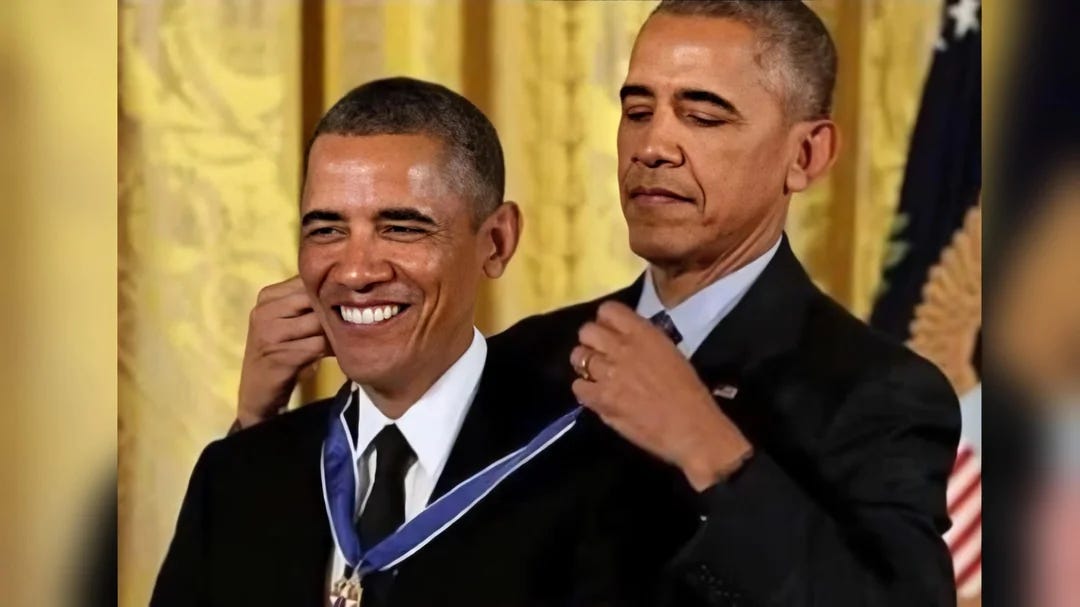
An image of the popular meme of Obama giving himself the Medal of Honor. Not too dissimilar from when Netflix puts its own movies in the “Most Popular” rail of its own app.
That tension doesn’t invalidate the record. It describes the conditions under which the record was produced. Which is, as it turns out, the same story as everything else in this pipeline: people doing necessary work inside a structure that wasn’t built to require it, producing something real anyway, with no guarantee it continues.
If you’re here from LinkedIn: welcome. If you found this some other way: the three pieces that preceded it are linked below. They’re worth reading in order.
PART ONE: The Pipeline Nobody Owns
PART TWO: The Handoff Nobody Made
PART THREE: The Audience Nobody Saw
The film and television excerpts embedded in this piece are used for purposes of criticism, commentary, and public interest journalism under the Fair Use doctrine (17 U.S.C. § 107). All clips are brief, selected specifically to illustrate the critical argument being made, and are not a substitute for the original works. I am aware that automated copyright systems may not distinguish between fair use and infringement, and that a copyright strike may result in this article being taken down in its entirety.